CPAP Finally Fixed Your Breathing. Why Is It Destroying Your Hips and Lower Back Every Morning?
"My CPAP stopped my snoring. Then it wrecked my left hip." Why lowering your apnea score locks your pelvis in a 6-hour mechanical trap, why both your bottom and top hip ache at 3:00 AM, and the 10-second knee-level fix that never touches your mask or hose.

Your CPAP finally moved the numbers that mattered.
Your AHI dropped from 38 down to 1.8. You stopped gasping for air at 2:00 AM. Your spouse moved back into the bedroom. For the first time in a decade, your daytime brain fog lifted.
But three weeks into finally sleeping through the night, you woke up to a new kind of misery nobody warned you about.
A deep ache inside one side of your hip, and that tight pulling burn down the outside of the other.
And a stiff, locked-up lower back that forces you to sit on the edge of the mattress for two full minutes every morning, holding onto the nightstand just to stand up and walk to the bathroom.
When you brought it up at your follow-up appointment, your sleep doctor or respiratory therapist probably gave you a polite shrug:
"It's impossible that your CPAP is causing hip pain. A CPAP only blows air into your airway. It must be your mattress, or arthritis, or just getting older."
So you started searching for answers on your own.
You tried stuffing an extra bed pillow between your knees. You tried a memory-foam mattress topper. You bought a giant full-body pregnancy pillow.
You stretched before bed, took midnight ibuprofen, and wondered if you were developing hip bursitis or sciatica.
Nothing stopped the 3:00 AM hip burn. Worse, half the pillows you tried bumped into your mask frame or tugged on your CPAP hose.
And nobody gave you a real mechanical explanation.
Until I started cross-referencing the sleep history of my own physical therapy patients over 55, and uncovered the exact same mechanical pattern happening inside their bedrooms.
Then I Saw Something That Made No Sense
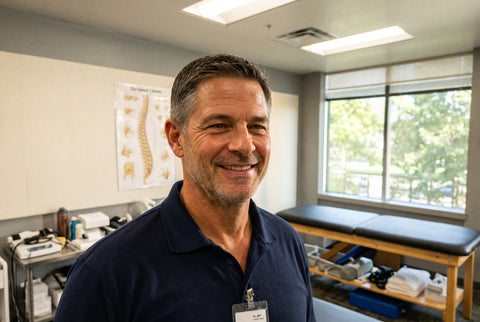
Over the past two years in my orthopedic clinic, I noticed a strange pattern among patients over 55 coming in for sudden hip bursitis and morning lower-back stiffness.
Different body types. Different mattresses. Different activity levels.
Yet dozens of them had started CPAP therapy within the previous 60 days. And when they sat on my treatment table, they didn't just describe similar symptoms. They used the exact same words:
"Dr. Cole, my hip pain is SO much worse since I started CPAP. My machine fixed my snoring and my apnea events are under 2, which I love. But now I sleep like a dead body on my left side for 6 hours straight because I'm afraid of breaking my mask seal. Around 3:30 AM, BOTH of my hips are on fire and my lower back feels twisted in a vise. My sleep clinic told me it's impossible it's the CPAP. Am I going crazy?"
When I evaluated these patients in their exact CPAP sleeping posture, one clinical finding explained the entire paradox:
"Your CPAP didn't injure your hip through the air hose. Your CPAP cured the micro-arousals that used to make you toss and turn every 20 minutes, leaving your pelvis locked in an unbraced side-sleeping position for 6 hours straight."
That single finding explained everything.
Your CPAP had done its job for your airway. It had not protected your hips and spine from six hours of motionless side-sleeping.
Before CPAP, your brain woke up 20 to 40 times an hour to restart your breathing. Every time you had a micro-arousal, you shifted your hips, rolled over, and restored blood flow to your joints.
You slept terribly, but you never stayed in one position long enough to crush your hip joint or twist your lower spine.
It Wasn't Your Mattress. It Was A 6-Hour Alignment Trap Nobody Explained.
When CPAP finally gives you deep sleep, it also forces you onto your side (because sleeping on your back makes airway gravity worse) and trains you not to move so your mask won't leak.
Here is what happens when you lie frozen on one side for 6 to 8 hours with nothing bracing your knees:

The 6-Hour "CPAP Freeze"
Because your mask and hose tether you to one side of the bed and your brain finally enters deep sleep, you stay pinned in a single lateral posture for 5 to 7 hours without shifting. Your joints take continuous static load they never experienced before CPAP.
Bottom-Hip Joint Compression
For six straight hours, the dead weight of your pelvis presses your bottom hip bone directly into the mattress. Worse, when your top leg slides forward, it rolls your pelvis at an angle that grinds the bottom hip bursa against the bone.
The Top-Hip "IT Band Tourniquet"
CPAP side sleepers always ask me: "Dr. Cole, I understand why the hip I'm lying on hurts. Why is my TOP hip burning at 3:00 AM when nothing is even touching it?"
Your pelvis is wider than your knees. The moment your top knee drops forward onto the mattress in front of your bottom leg, two destructive forces fire at once:
First, your thick iliotibial (IT) band and gluteal tendon are stretched taut across the outside of your top hip bone like a ratchet strap. For six hours, that stretched band acts like a physical tourniquet, squeezing the joint and cutting off local blood flow until the top hip wakes you up throbbing at 3:00 AM.
Second, the weight of that dropped leg pulls your pelvis forward and holds your lower back vertebrae in a continuous twist all night long.
I Looked For What My Patients Needed. Nothing Worked With CPAP.
Once my CPAP patients understood that their hip and back pain came from their top leg collapsing across their body during deep CPAP sleep, they all tried the same household fixes first.
And every single one failed for a specific mechanical reason:

The Orthopedic Knee Spacer Built For CPAP Sleep
To solve CPAP hip pain without disturbing your mask seal, a positioning tool has to do four things at once: hold your legs parallel at hip-width for 8 hours, never flatten under heavy leg weight, move with your leg when you turn, and stay three feet away from your CPAP mask.
That is why physical therapists and thousands of CPAP side sleepers have switched to the Nourial Knee Alignment Pillow.

Dual-Leg Concave Groove: Instead of a flat pillow that lets your knee roll off, Nourial cradles both your bottom and top knee in deep anatomical grooves. It locks your thigh bone at neutral hip-width so your IT band goes slack, your top hip decompresses, and your pelvis stacks squarely instead of grinding into the mattress.
High-Density Orthopedic Memory Foam: Built specifically for lower-body leg weight, Nourial's high-density core holds its exact height from 10:00 PM to 6:00 AM. It never goes flat at 2:00 AM or loses its shape after a few weeks.
Soft Stay-Put Leg Strap: If you roll from one side to the other to adjust your CPAP hose at 3:00 AM, you never have to wake up or reach under the covers. The soft, stretchy strap keeps the pillow gently aligned between your knees all night long.
Cooling Airflow Core (100% Mask-Safe): Because it sits strictly between your knees with a ventilated center airflow channel, it never traps sweat and stays completely out of the way of your CPAP mask, headgear, and hose.

Watch Out for the "Ankle Fulcrum Effect"
When you place a spacer between your knees, heavy ankles that hang unsupported can act like a seesaw, tilting your shin downward and rotating your thigh bone inward at the hip socket. Keeping both your knees and ankles supported on one level plane delivers complete decompression from hip to ankle.
FLASH SALE: 50% OFF FOR NEW CUSTOMERS
“I was skeptical too, but with a 60-night comfort guarantee, there’s zero risk in testing it alongside your CPAP in your own bed.”
👉 CHECK AVAILABILITYStock Alert: High demand. Ships fast with priority tracking.
What Happens During The 5-Night CPAP Hip Challenge
You don't need six months to know if your hip and lower back pain came from CPAP side-sleeping twist. Because the IT Band Tourniquet and pelvic rotation are mechanical problems, removing the load produces a fast night-by-night shift:
⚡ THE 5-NIGHT CPAP HIP CHALLENGE ⚡
Immediate Slack on the Top Hip: The moment you strap the Nourial pillow between your knees and put your CPAP mask on, you feel the tight pull across the outside of your top hip and lower back let go. Your pelvis sits flat instead of twisted.
Zero 2:00 AM Pillow-Hunting: When you shift position in your sleep, the soft strap moves effortlessly with your leg. No waking up to fish a flattened pillow out from the foot of the bed, and zero tugging on your CPAP hose.
The 3:00 AM Hip Burn Fades: With your top leg supported at hip-width and your bottom hip no longer grinding at an angle, local blood flow stays open through your full 6-hour CPAP stretch.
Sleeping Straight Through to Your Alarm: Your CPAP keeps your airway open while Nourial keeps your pelvis neutral. For the first time, your machine and your joints stop fighting each other.
Standing Up Straight on Step One: You take your CPAP mask off at 6:30 AM, swing your legs over the side of the bed, and walk straight to the coffee pot without hobbling, wincing, or bracing your hands on the nightstand.
Why CPAP Side Sleepers Are Switching To Nourial
The strongest proof isn't a promise. It's what happens at 6:00 AM for side sleepers who thought they had to choose between breathing at night and walking without hip pain in the morning:
 Richard M., 63, Michigan · ✓ Verified Buyer
 Deborah K., 58, Florida · ✓ Verified Buyer
 Greg T., 67, Texas · ✓ Verified Buyer
You Have Two Choices Right Now

You have already done the hard part of getting used to your CPAP mask, your air pressure, and your nightly routine.
Right now, you can keep trying to survive the night by stuffing flat head pillows between your knees, waking up at 3:00 AM with both hips throbbing, and hobbling to the bathroom every morning while your lower back unlocks.
Or you can take the 5-Night CPAP Hip Challenge with the orthopedic knee spacer built to hold your hips and spine in neutral alignment for all 8 hours of deep CPAP sleep, backed by a 60-Night Risk-Free Trial.
Here's Exactly What Happens When You Order:
- TODAY: Claim your Nourial Knee Alignment Pillow at 50% OFF on the next page. Your order confirmation arrives immediately by email.
- WITHIN 24 TO 48 HOURS: Your Nourial Knee Alignment Pillow ships with tracked delivery straight to your door.
- NIGHT 1 TO NIGHT 5: Slip the soft strap onto your leg in 10 seconds before putting on your CPAP mask. Pay attention to how your top hip feels at 3:00 AM and how your lower back feels during your first ten steps out of bed.
- DURING YOUR 60-NIGHT TRIAL: Sleep on it for two full months. If you don't wake up without the 3:00 AM hip burn and morning hobble, simply return it for a 100% refund of every penny.
LOW STOCK · SELLING FAST: As of November 2026, demand for the Nourial Knee Alignment Pillow among CPAP side sleepers has increased dramatically. Lock in your order now for 50% OFF ($39.95 instead of $79.99) + FAST TRACKED SHIPPING while current promotional inventory remains in stock.

SECRET FLASH SALE: 50% OFF FOR A LIMITED TIME ONLY!
This limited-time CPAP reader deal is in high demand and stock keeps selling out.
60-Night CPAP Side-Sleep Trial

60-Night CPAP Side-Sleep Trial: Wake Up Without The 3 AM Hip Burn Or Pay Nothing.
Test the Nourial Knee Alignment Pillow in your own bed alongside your CPAP for 60 full nights. If it doesn't stay in place all night, release the pull on your top and bottom hip, and let you stand up straight in the morning, send it back for a full, prompt refund. No hassle, no questions asked.
P.S. Your CPAP fixed your breathing. Don't let 6 hours of unbraced side-sleeping undo the rest of your body. Click the green button above to lock in 50% OFF ($39.95 instead of $79.99) while current batch inventory is in stock.
Clinical & Biomechanical References
- Cary, D., Briffa, K., & McKenna, L. (2019). Identifying relationships between sleep posture and non-specific spinal symptoms in adults: A scoping review. BMJ Open, 9(6), e027633. (Documenting asymmetrical side-lying lumbar and pelvic rotation when the top knee drops across the midline).
- Grimaldi, A., Mellor, R., Hodges, P., Bennell, K., Wajswelner, H., & Vicenzino, B. (2015). Gluteal tendinopathy: A review of mechanisms, assessment and management. Sports Medicine, 45(8), 1107-1119. (Demonstrating iliotibial band tension and compressive load across the greater trochanter during hip adduction in side-lying).
- Gordon, S. J., Grimmer-Somers, K., & Trott, P. (2007). Sleep position, age, gender, sleep quality and waking cervico-thoracic and lumbar symptoms. Internet Journal of Allied Health Sciences and Practice, 5(1).